


Under EPR, compliance isn’t just about meeting targets, it’s also about managing the cost of not meeting them. Environmental Compensation (EC) is applied when obligations fall short, and it’s not a one-time penalty. Shortfalls carry forward, refunds reduce over time, and delays quickly become expensive. Understanding how this works is critical to making better sourcing and compliance decisions.
Why EC Is Often Misunderstood
Most companies look at EPR from a reporting lens, targets, filings, documentation. What gets missed is what happens when those targets aren’t met.
OECD research highlights that EPR systems are designed to internalise environmental costs into producer responsibility frameworks, meaning compliance is not just a reporting obligation but an economic mechanism embedded into product decisions.
Environmental Compensation isn’t just a penalty you pay and move on from. It’s structured in a way that directly affects cost, timelines, and future compliance. And if it’s not factored in early, it tends to show up as an unexpected financial hit.
How the Penalty Structure Actually Works
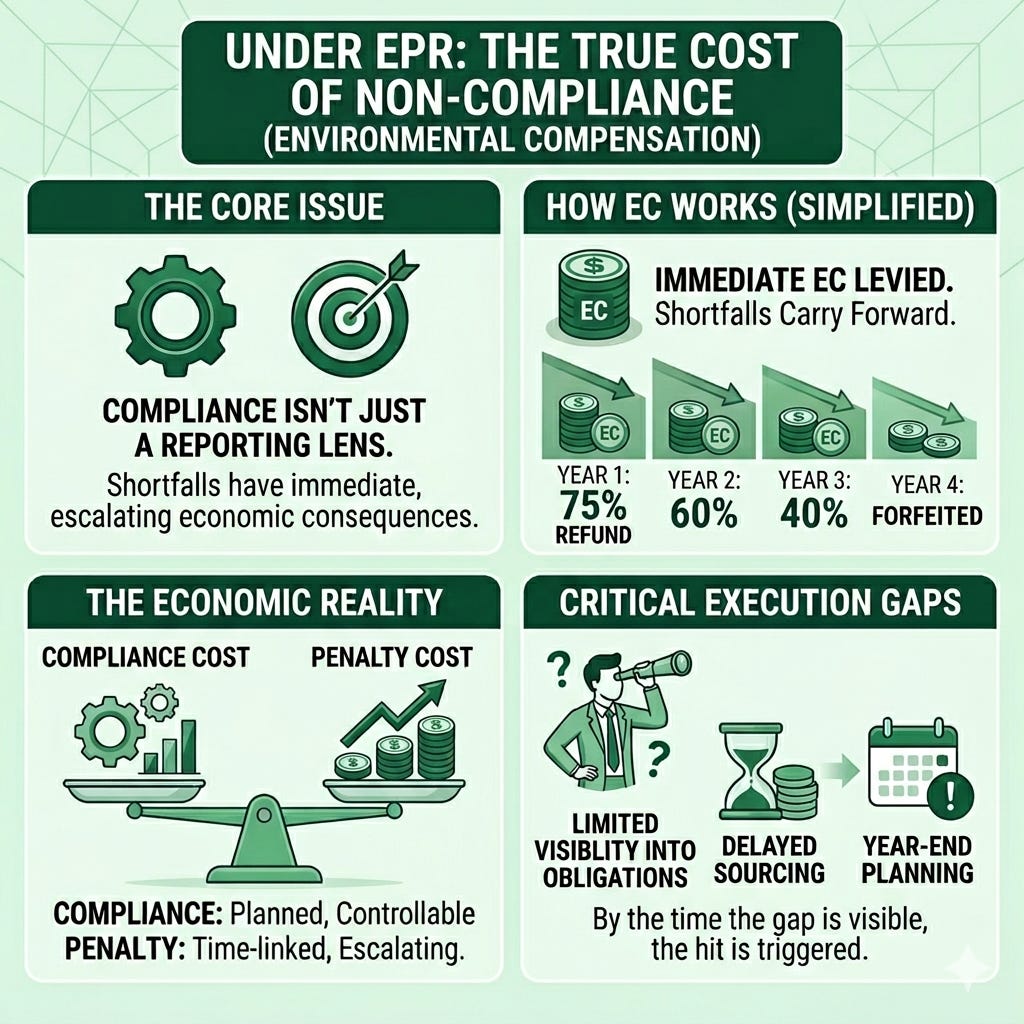
Under EPR, any shortfall in meeting obligations doesn’t disappear, it carries forward for up to three years.
At the same time, EC is levied immediately, based on the polluter pays principle. This means the cost is applied upfront, even if the shortfall is addressed later.
Academic research on India’s application of the polluter pays principle highlights that environmental compensation is not arbitrary, but a structured mechanism used to quantify environmental damage and assign financial liability proportionate to the shortfall.
There is a provision for a refund, but it reduces over time:
- 75% refund if fulfilled in Year 1
- 60% refund in Year 2
- 40% refund in Year 3
- Fully forfeited after that
In effect, the longer the delay, the higher the real cost of non-compliance.
Why This Becomes a Cost Problem
This is where most companies underestimate the impact.
At first glance, delaying compliance might seem manageable—especially if sourcing compliant material or credits is difficult. But when you factor in EC, the economics change quickly.
Compliance cost vs. penalty cost isn’t a simple comparison:
- Compliance cost is planned and controllable
- Penalty cost is time-linked and escalating
What looks like a short-term saving often turns into a higher long-term expense.
Where Things Typically Break Down
The issue usually isn’t intent, it’s execution.
Common gaps include:
- Limited visibility into actual obligations
- Delayed sourcing of compliant materials or credits
- Weak supplier verification
- Treating compliance as a year-end activity
By the time the gap is visible, EC has already been triggered.
Conclusion: From Reactive Penalties to Structured Compliance
Environmental Compensation is designed to push timely compliance, not just penalize delays.
But in practice, it exposes a bigger issue, lack of structure in how companies approach EPR. When compliance is treated as an afterthought, penalties become unavoidable.
At Fitsol, the focus is on building that structure early, bringing visibility into obligations, aligning sourcing with targets, and enabling decisions that hold up over time.
Because under EPR, the real cost isn’t just non-compliance.
It’s the delay in getting compliance right.
FAQs
What triggers Environmental Compensation under EPR?
Environmental Compensation kicks in when an entity misses its EPR targets within the specified timeline. It is levied on the gap itself, in line with the “polluter pays” principle. Even if the shortfall is later fulfilled, the penalty for that period still stands.
Can Environmental Compensation be recovered later?
Yes, but only partially and within a defined window. Any recovery reduces over time, typically starting higher in the first year and tapering down to nil after a few years. In short, the longer the delay, the lower the benefit of correction.
How should companies think about EC from a cost lens?
EC shouldn’t be treated as a backup plan. It’s more useful as an early warning signal. When companies compare compliance costs with potential penalties upfront, decisions become more proactive. In most cases, planned compliance is significantly more cost-efficient than reacting after the gap appears.
Do you think most companies today are treating Environmental Compensation as a real cost signal, or is it still viewed as just another compliance penalty? Share your thoughts in the comments.
Join our LinkedIn community, The Decarbonisation Exchange: Procurement · Supply Chain · Sustainability, and WhatsApp network, Net Zero Community, for ongoing discussions, insights, and updates.