


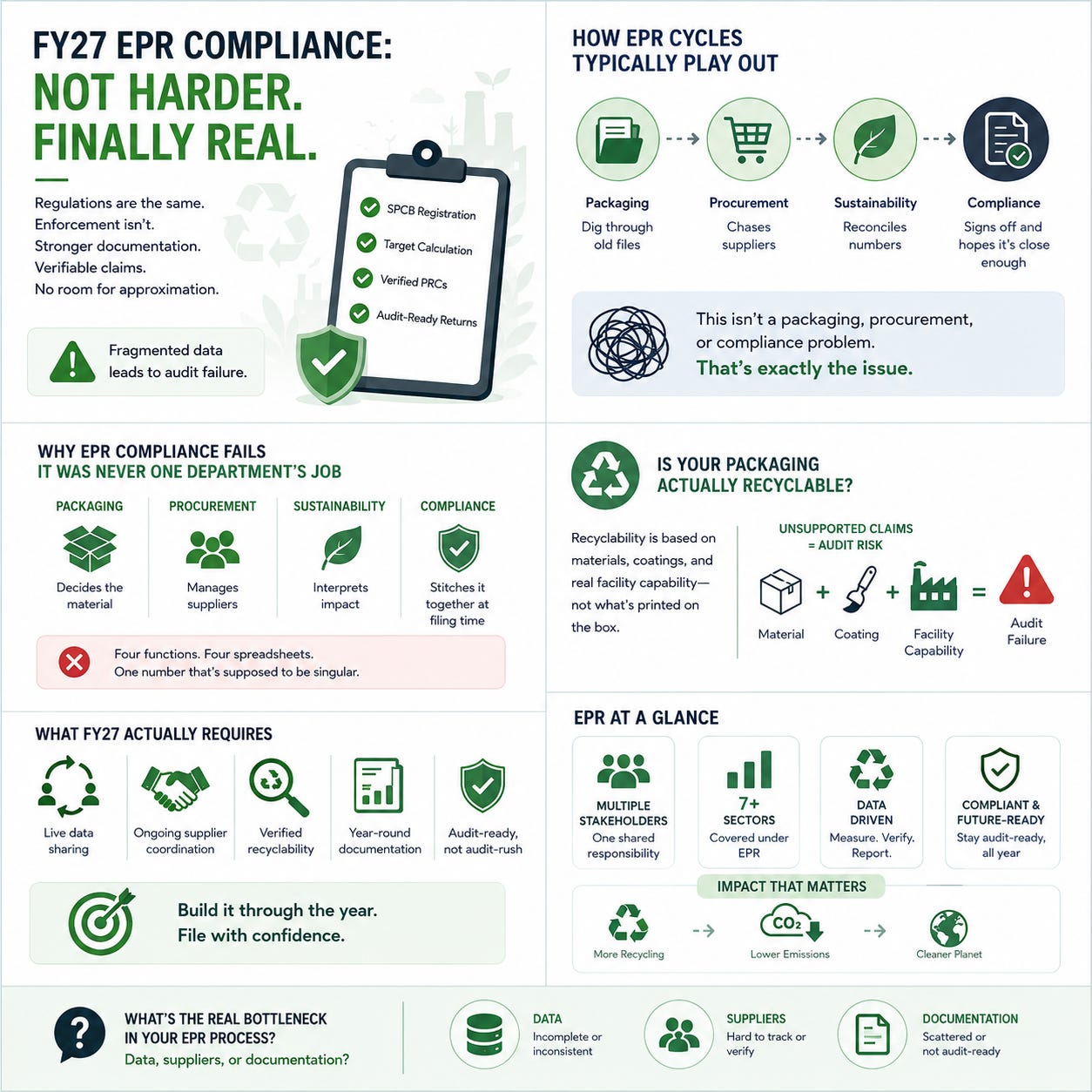
EPR compliance in FY27 requires registration with the State Pollution Control Board, accurate target calculation, verified recycling certificates (PRCs), and audit-ready annual returns. The Plastic Waste Management Rules remain unchanged, but CPCB enforcement now demands stronger documentation and verifiable recyclability claims, exposing businesses with fragmented compliance data to audit failure.
Every EPR cycle plays out the same way. Packaging teams dig through old files. Procurement chases suppliers. Sustainability reconciles numbers that don’t agree. Compliance signs off and hopes it’s close enough. This isn’t a packaging, procurement, or compliance problem. That’s exactly the issue.
Why EPR Compliance Fails: It Was Never One Department’s Job
Packaging decides the material. Procurement manages suppliers. Sustainability interprets impact. Compliance stitches it together at filing time. Four functions, four spreadsheets, one number that’s supposed to be singular — and nobody owns it end to end.
This isn’t just an internal observation. A 2023 study in the Social Responsibility Journal examining EPR implementation in India found stakeholders consistently citing a lack of clarity in policy execution, including inconsistent technical definitions and unclear recycler registration processes (Gupta & Dash, 2023). When the system itself lacks clarity, four departments producing four different numbers isn’t surprising, it’s predictable.
Is Your Packaging Actually Recyclable?
A package is genuinely recyclable based on materials, coatings, and whether facilities can actually process it, not what’s printed on the box. Under FY27’s tighter scrutiny, an unsupported recyclability claim isn’t a marketing risk anymore. It’s grounds for a failed PRC audit.
Research published in Resources, Conservation and Recycling analysing India’s shift to EPR-based waste management identifies execution and implementation as critical constraining factors alongside policy design (ScienceDirect, 2021). The Centre for Science and Environment’s review of India’s EPR regime similarly examines registration and verification gaps as central to the system’s efficacy (CSE, 2023).
What FY27 Actually Requires
Packaging and procurement sharing live material data. Supplier coordination as an ongoing relationship, not an annual email. Recyclability verified against real facility capability. Documentation built year-round, so filing is a review, not a reconstruction.
The Bottom Line
EPR compliance isn’t getting harder because regulations changed. It’s getting harder because businesses that were never going to survive a CPCB audit are finally being asked to prove what they’ve filed for years.
Fitsol runs EPR as a continuous, fully managed engagement, registration, target calculation, verified recycler sourcing, and audit-ready filings, so documentation stays current year-round.
Map your packaging and supplier data before FY27 filing season starts.
FAQs
What is changing in EPR compliance for FY27?
The framework is unchanged, enforcement isn’t. CPCB is increasing scrutiny on documentation and certificate validity, exposing businesses that relied on annual approximation.
How does Fitsol help businesses manage EPR compliance?
Fitsol manages registration, target calculation, verified recycler sourcing, and audit-ready filings as one continuous engagement, not an annual scramble.
What’s the real bottleneck in your EPR process, data, suppliers, or documentation? Tell us in the comments.
Join our LinkedIn community, The Decarbonisation Exchange: Procurement · Supply Chain · Sustainability, and WhatsApp network, Net Zero Community, for ongoing discussions, insights, and updates.