


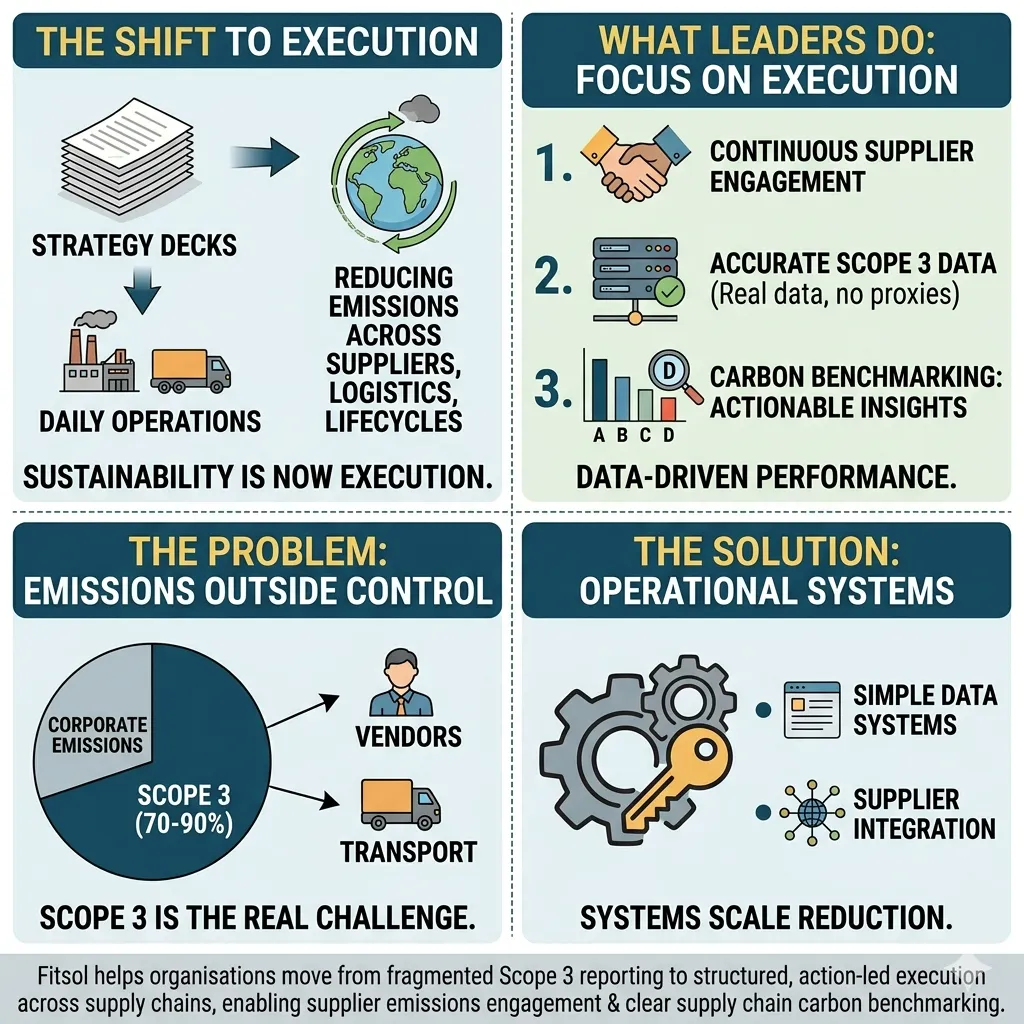
Supply chain emissions reduction action means measuring, managing, and reducing emissions across suppliers, logistics, and product lifecycles, not just within company walls. The way things are evolving today, sustainability can no longer be restricted to intent, it needs to be supported by strong execution. Therefore, we see that supply chain emissions reduction action is shifting from strategy to execution.
The Real Emissions Problem Lies in the Supply Chain
Most emissions sit outside direct control, like vendors, transport and raw materials. That’s why supply chain decarbonization leaders are looking across the entire value chain, not just inward.
In a study, published by the Journal of Cleaner Production, it was seen that scope 3 emissions often account for 70–90% of total corporate emissions, making them the dominant source of climate impact across industries.
However, due to missing supplier data, most companies are forced to rely on secondary estimates, according to a study published in the journal npj Climate Action. This weakens the accuracy of scope 3 reporting India manufacturing and global supply chains.
The message is simple. If you are not addressing the emissions generated by your supply chain, you are not addressing the real emissions problem.
What leaders are doing differently today
They are focusing on execution, instead of overcomplicating it. First, supplier emissions engagement is structured: Companies are building continuous supplier systems with clear expectations and regular data exchange.
Second, data is treated as infrastructure: Accurate scope 3 reporting, real supplier-level data. Because without data, reduction is guesswork.
Third, supply chain carbon benchmarking is driving action: Companies compare suppliers, identify hotspots, and prioritise interventions based on real emissions intensity. This is turning sustainability into performance management.
India is at a turning point
India’s manufacturing ecosystem is expanding rapidly. But challenges remain:
- Gaps in supplier data
- Uneven digital maturity
- Lack of standardised systems
This is why supply chain sustainability best practices are no longer optional, but critical.
The Real Gap: Execution
Most organisations already know what needs to be done. The real failure point is execution. Too often, organisations:
- Measure emissions without acting
- Collect data without using it
Treat sustainability as reporting, not operations
What actually works is clear:
- Simple, repeatable data systems
- Continuous supplier engagement
- Alignment between procurement and sustainability
- Benchmarking to prioritise real impact
Without this, sustainability doesn’t scale.
This is where Fitsol is shaping the conversation. Not just as a tool, but as a system for execution, bringing together supplier engagement, real-time data, and carbon benchmarking into one operational layer.
Conclusion
Decarbonization is no longer a strategy problem. It is an execution challenge. The companies that will lead are not those with the most ambitious targets, but those that can act consistently across their value chain.
FAQs
What are the top 5 contributors to carbon emissions?
Electricity and heat are the largest contributors to carbon emissions globally, followed by transportation, manufacturing and construction. Even agriculture and buildings significantly add to carbon emissions.
What is supply chain emissions reduction action?
Supply chain emissions reduction actions are measures taken by industries to reduce greenhouse gas production across their entire value chain. It includes upstream activities like sourcing raw materials and working with suppliers, as well as downstream stages such as transportation, product use, and disposal.
Why is Scope 3 emissions reduction difficult?
Because it depends on external stakeholders like suppliers, logistics partners, and infrastructure. Limited data, varying capabilities, and lack of standardisation make it harder to measure and act consistently across the value chain.