


Under India’s EPR framework, packaging category is not just a technical classification anymore. It directly affects what a company is expected to comply with.
Different categories come with different recycled content targets, recycling obligations, and reuse requirements. Which also means that if packaging is classified incorrectly, the issue usually doesn’t show up only during reporting. It starts much earlier, at sourcing itself.
Why Packaging Category Matters
A lot of companies still treat packaging classification as a documentation exercise. But in practice, it influences almost everything that follows under EPR.
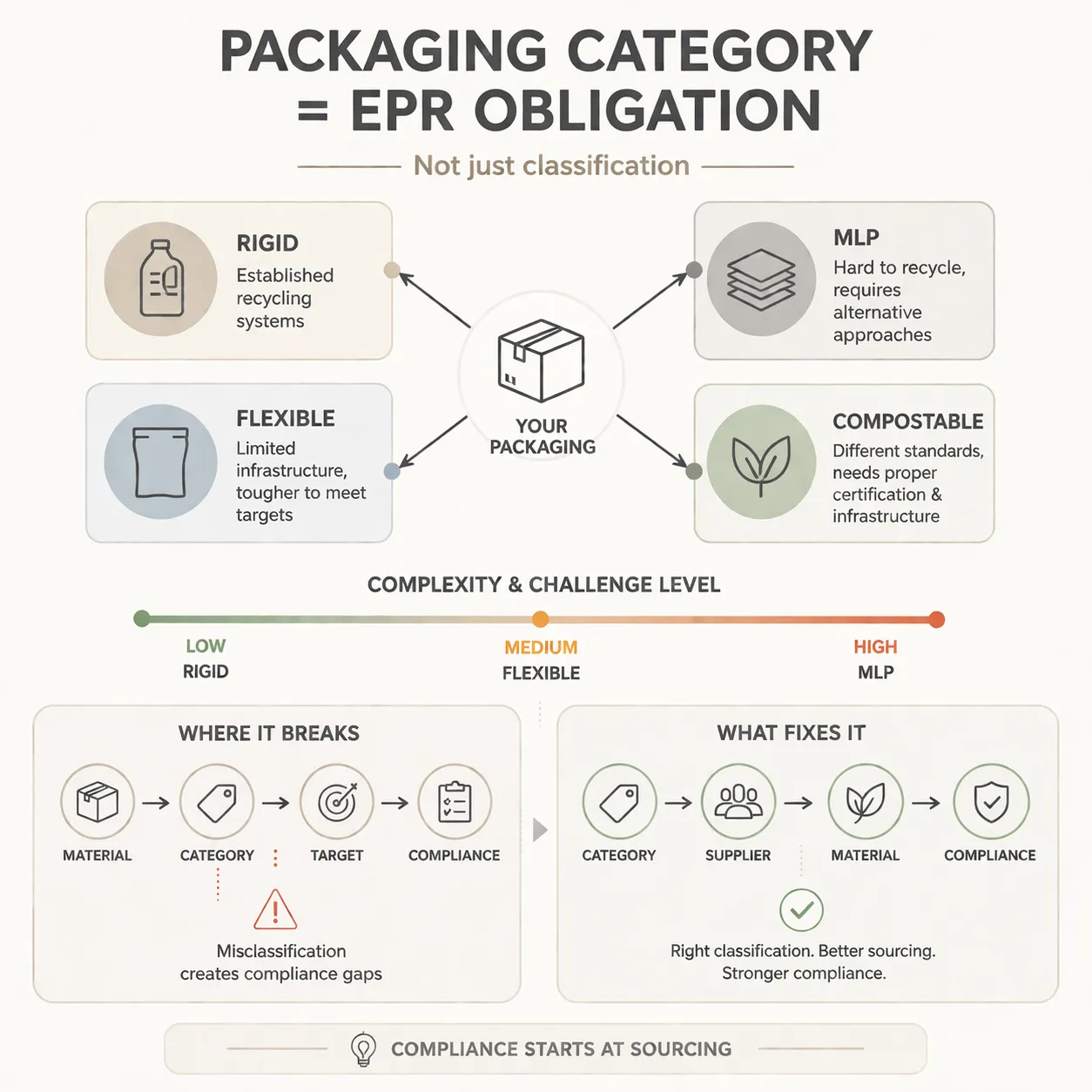
India’s framework broadly covers four categories:
- rigid plastic
- flexible plastic
- multi-layered plastic (MLP)
- compostable packaging
Each one is treated differently under the rules. So assigning the right category is not just about labelling packaging correctly. It affects targets, material choices, supplier requirements, and eventually how achievable compliance actually becomes.
What Changes Across Categories
The challenge level varies quite a bit across categories.
Rigid plastics are comparatively easier because recycling systems are more established and material availability is relatively more stable.
Flexible plastics are harder to manage operationally. Infrastructure is still developing, which makes supplier capability and sourcing consistency much more important.
MLP remains one of the most difficult areas because recyclability itself is limited. In many cases, companies end up looking at redesign, reduction, or material substitution instead.
Compostable packaging brings its own complexity too, especially around certification, traceability, and whether processing systems actually exist on-ground.
Where Problems Usually Start
In many cases, the issue is not the target itself. It’s the way packaging gets classified internally.
For example, treating a multi-layered structure as flexible, or assuming compostable packaging automatically solves compliance requirements, can create gaps that surface much later.
And this happens more often than expected, especially when procurement, sustainability, suppliers, and compliance teams are working separately from each other.
Why This Is Becoming a Sourcing Issue
Once packaging is classified, compliance depends heavily on whether sourcing decisions actually support those requirements.
That includes:
- understanding material composition properly
- knowing what suppliers can realistically provide
- tracking recycled content at a material level
- checking whether packaging aligns with category-specific obligations
Without this visibility, compliance becomes difficult to manage consistently.
At this point, EPR is becoming less of a reporting exercise and more of an operational one.
Conclusion
Packaging category now shapes much more than reporting. It affects sourcing decisions, supplier alignment, material visibility, and how manageable EPR actually becomes on-ground.
A lot of compliance gaps today are not happening because companies don’t know the rules. They happen because packaging, procurement, and operational systems are still not fully connected.
At Fitsol, the focus is on helping companies bring more visibility into this process so packaging decisions are easier to track, validate, and align with EPR requirements in practice.
FAQs
Why is packaging classification important under EPR?
Because everything starts from there. The category you assign decides what targets you’re working with recycled content, recycling, sometimes even reuse. If that starting point is off, you’re basically building compliance on the wrong base.
What are common mistakes in packaging classification?
It’s usually not intentional just oversimplified. Things like treating multi-layered packaging as flexible, or assuming compostable automatically works. These seem small at first, but they tend to show up later when numbers don’t add up.
How can companies improve EPR compliance across categories?
It’s less about doing one big thing and more about getting the basics right. Clear classification, knowing what materials you’re actually using, and being realistic about what suppliers can deliver. Once that’s in place, compliance becomes a lot more manageable.
Do you think most companies today have enough operational visibility to manage category-level EPR requirements properly? (Answer in the comment section)
Join our LinkedIn community, The Decarbonisation Exchange: Procurement · Supply Chain · Sustainability, and WhatsApp network, Net Zero Community, for ongoing discussions, insights, and updates.