


Akshay Tandon, CTO & Co-Founder, Fitsol
What’s changing
On 19 October, The Economic Times reported preliminary discussions between the finance and commerce ministries about measuring Scope 3 emissions for exports to all countries. No decision has been taken. The question extends beyond sales to markets introducing carbon border measures, such as the EU and UK, and comes as the GHG Protocol revises the standards many companies use to account for value-chain emissions.
The GHG Protocol’s March 2026 progress update suggests where its Scope 3 revision may be headed. Under the proposals, each category would be broken down by data type, including an “Unclassified” tier where companies cannot or choose not to make that split. Anyone verifying some or all of its Scope 3 emissions would also disclose how much it verified.
The boundary proposals are more prescriptive: report at least 95% of required Scope 3 emissions and quantify the full total annually to justify exclusions. Alongside these requirements, the update recommends targets to increase data specificity, track supplier participation, and improve data quality over time. These remain proposals, with important details still open.
For companies buying from diversified suppliers, another proposal deserves attention. It would restrict the allocation of corporate-level supplier emissions to “homogeneous” businesses, whose emissions are relatively uniform across operations. Taking a diversified group’s consolidated emissions and assigning a portion according to your share of its revenue would no longer be an acceptable shortcut for attributable production emissions. More granular data, for example at facility or product level, would be needed. The draft retains an allowance for allocating non-attributable corporate overheads, and the definitions of “homogeneous” and “diversified” are still being developed.
The July development plan estimates public consultation on a consolidated draft in Q2 2027 and publication in Q4 2028. That is a working timetable, subject to change.
There is already a commercial reason to get the records right. The EU’s CBAM entered its definitive regime on 1 January 2026. For covered goods, importers using default emissions values face sector-specific markups: 10% in 2026, rising to 30% from 2028 for cement, iron and steel, aluminium and hydrogen. Fertilisers carry a separate 1% markup. CBAM’s product-emissions rules are distinct from the proposed corporate Scope 3 revisions, but both make the quality of underlying records consequential.
In India, SEBI made value-chain ESG disclosure voluntary for the top 250 listed companies from FY 2025–26. Voluntary disclosure does not necessarily mean a quieter inbox for their suppliers. Customers can still ask for the data.
What it means for you
What stands out to me is the prospect of having to show the mix of data behind an inventory. Companies would retain choices about the data they use, while making those choices easier to examine. The GHG Protocol itself cautions that data type alone does not establish accuracy. A figure taken directly from a supplier’s annual report may still be a poor fit for the particular product you bought.
Sector averages can obscure real differences. A foundry that has invested in an induction furnace and rooftop solar may look much like a neighbouring plant when both receive the same average emissions factor. If buyers can see how heavily an inventory relies on averages, some are likely to ask which suppliers those averages represent.
For a manufacturer trying to answer that question, much of the evidence may already exist. Finding it is another matter. Finance has GST invoices and Tally ledgers. The plant keeps its own spreadsheets, while freight records sit in scanned challans or email attachments. Somewhere in the chain, a photograph of a bill has probably arrived on WhatsApp. An ERP rarely brings all of this together on its own.
A leading manufacturing enterprise brought more than 120 suppliers onto a single reporting system, allowing them to allocate emissions to specific products rather than estimate them from spend while reducing manual reporting effort by 63%.
Can AI fix it?
AI can take on a fair amount of the drudgery. Reading documents in different languages, matching invoice lines to emission factors and flagging a tenfold jump in electricity use are plausible uses, although performance needs testing on the files a factory actually handles. Automated reminders may also help with supplier follow-up.
Missing evidence is harder. If a supplier stopped using diesel gensets last year, the system needs a credible record of that change before it can reflect it in the inventory.
Some fairly ordinary work makes these tools much more useful:
- One supplier record across systems. GSTIN is a useful starting point for linking Tally entries with ERP records and invoices. Check where a supplier has several registrations or plants, so the link does not erase differences that matter.
- Before choosing software, locate the evidence for each major emissions category. A map of who holds which records will tell you more about the collection problem than a polished demo.
- Original documents should remain available. Summary sheets are convenient, but a verifier may need to trace a figure back to the bill or challan it came from.
- Someone needs to own the exceptions. A system can flag an anomaly. A person who understands the operation has to decide whether it is an error or a real change.
- Review the share of the inventory supported by primary data each quarter, with a realistic improvement target. Track specificity as well, since receiving a number directly from a supplier does not automatically make it representative.
Sooner or later, someone in finance or sales will ask, “Where did this number come from?” Having an answer that survives an auditor’s follow-up is a useful test of whether the process works.
How to choose a tool
I should declare my interest here: I co-founded Fitsol, and this is the work we do. The questions below should apply to us as readily as to any other provider.
When I assess a tool, I would start with how well it handles the records and suppliers already in the business, then ask how clearly it can explain the resulting numbers.
Traceability means being able to follow a figure back to its source document and see the emission factor applied. Supplier-reported values and modelled estimates should be distinguishable, with the data tier visible. Independent certification can provide evidence about a method, provided its scope covers the calculation you need.
Operational fit is more mundane, and easy to underestimate. Can the tool read your Tally exports and scanned challans? How does it handle an invoice in a regional language, or a small supplier answering on a phone? Its factor library also needs to suit the work, including relevant CEA grid factors and freight factors for India.
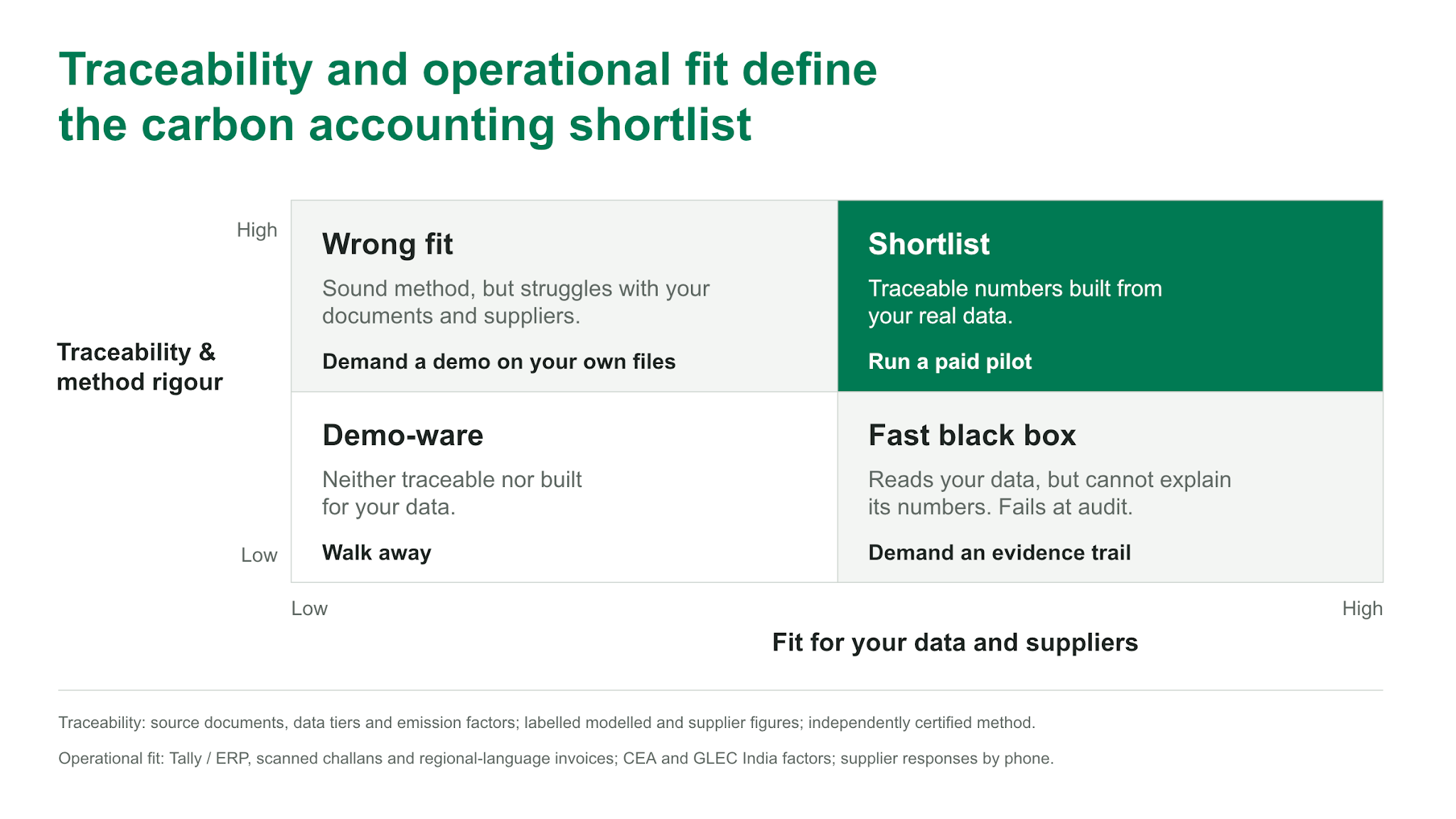
For the vertical axis, traceability and method rigour, I would ask:
- How much of the calculation uses physical activity data, such as fuel consumption or freight distance, and where does the tool fall back on spend?
- What has an independent body actually certified? Ask to see the scope, including whether a freight method covers the relevant requirements of ISO 14083.
- When supplier emissions need allocating to a product, can you inspect the basis of that allocation and the underlying facility or process data?
- Choose a reported figure and follow it back to the source. Are the data tier and emission factor visible, and can you distinguish a supplier’s reported value from an estimate?
- Separately, examine the provider’s security evidence, including the scope of any ISO 27001 certification or SOC 2 report. Those checks matter even when the emissions method is sound.
On the horizontal axis, fit for your data and suppliers, the questions become more practical:
- Give the provider a Tally export, an ERP file and some scanned documents, including regional-language invoices. What can it process without manual preparation?
- Which version of the CEA grid factors does it use? For freight, ask how it applies GLEC India factors and how updates reach an existing inventory.
- Could someone at a 40-person supplier unit complete the request on a phone, in their own language, in about ten minutes? Test that with a supplier.
- Once it identifies a major source of emissions, does the tool help you assess what could change and what doing so might cost?
A pilot should put these answers under pressure. Eight to ten weeks is a reasonable starting point, though supplier response times may dictate a longer run.
- Keep the scope manageable: one major category, often purchased goods, with around 25 to 30 suppliers. Include some of the smallest.
- Use three months of actual records. Keep the messy files in the sample, since they are part of the job the software will inherit.
- Plant a few known errors. A duplicate invoice is useful, as is a bill recorded in MWh that someone has labelled kWh. See whether the system catches an outdated grid factor too.
- Measure the starting point before the pilot begins. Record extraction accuracy and supplier response rates, along with the share supported by primary data and the hours your team spends per supplier.
- Agree in writing what would justify a purchase and what would stop it. Otherwise, a busy pilot can finish without resolving the buying decision.
- Bring the assurance provider into the final walkthrough. Ask them to trace a sample of figures without the project team explaining every step. Where they get stuck will tell you what still needs work.
I would use the period before the standard is final to work through the suppliers and records that are difficult today. By 2028, I’d like to see Indian manufacturers able to show where better operational performance has reduced their emissions. The useful question for now is how much of that evidence they could put on the table.
Sources
- The Economic Times, “Exporters may be asked to monitor supply chains’ indirect emissions”, updated 19 October 2026.
- GHG Protocol, Scope 3 Standard Revisions: Phase 1 Progress Update, March 2026. Draft proposals, subject to change.
- GHG Protocol, Consolidated Corporate Standard Development Plan, 29 July 2026. Estimated consultation and publication timetable.
- European Commission, CBAM definitive regime. Overview of the regime applying from 1 January 2026.
- Commission Implementing Regulation (EU) 2026/1740, Annex I. Corrected default values and sector-specific markups.
- SEBI circular, 28 March 2025, on assurance or assessment and value-chain ESG disclosures.