

What’s New at Fitsol
Featured Article: Empowering India’s Green Manufacturing Journey
As India pushes toward Net-Zero 2070, real-time carbon tracking and supplier ESG compliance are crucial for sustainable industrial growth. In his latest op-ed, Akshay Tandon, Co-founder & CTO, explains how Greencount and Greenalign enable data-led decarbonization, Scope 1–3 emissions monitoring, and measurable green manufacturing outcomes.
Read the full story: Empowering India’s Green Manufacturing Journey
On the Agenda: Webinars & Panels
Webinar: Bridging Policy & Practice – CCTS 2025 Greenhouse Gas Intensity Targets
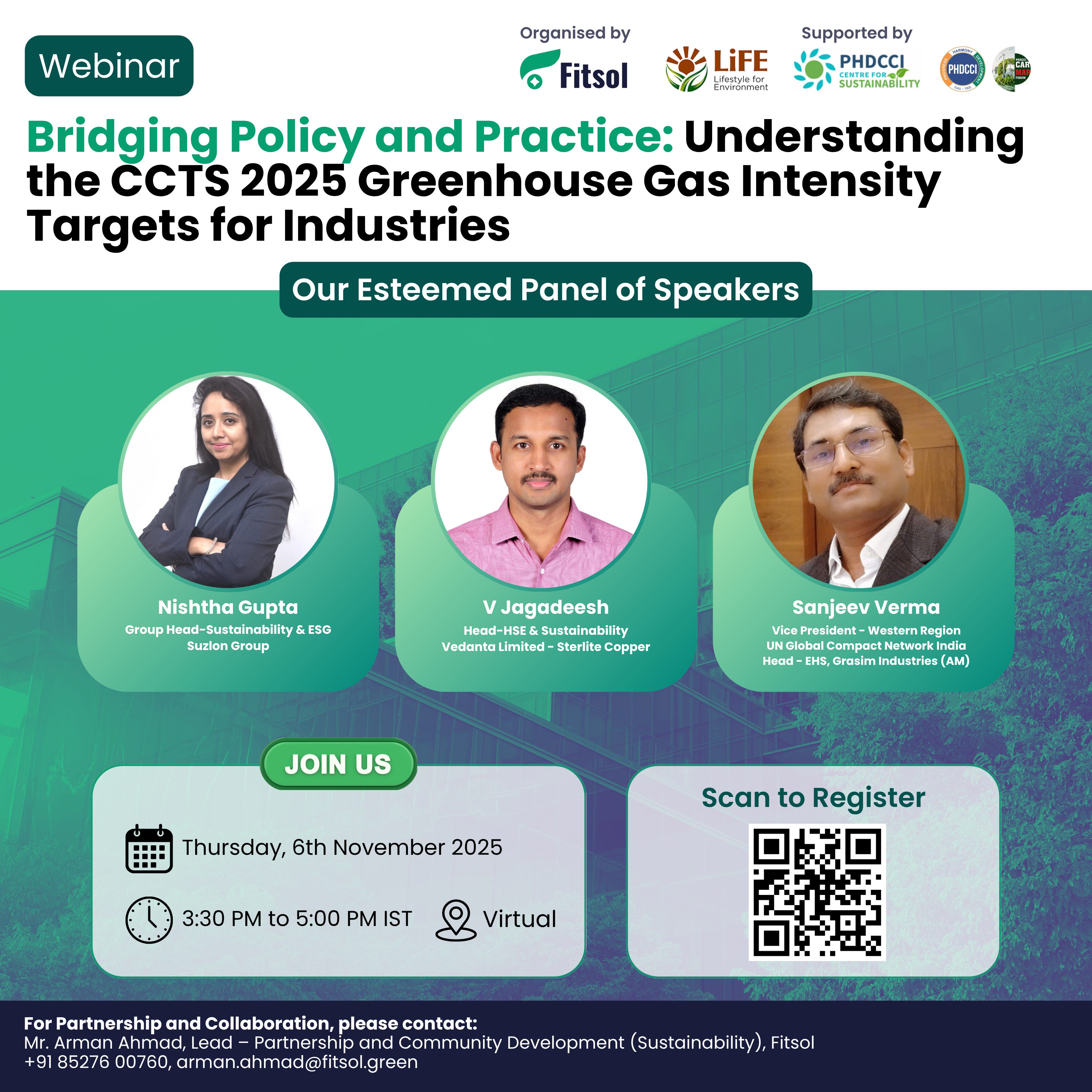
Fitsol, under the LiFE initiative and in collaboration with PHDCCI Centre for Sustainability, invites you to decode CCTS 2025 and its impact on India’s decarbonization journey.
Date: 6th November 2025
Time: 3:30 PM – 5:00 PM IST
Venue: Virtual
Speakers: Nishtha Gupta (Suzlon), V. Jagadeesh (Vedanta – Sterlite Copper), Sanjeev Verma (UN Global Compact Network India & Grasim Industries)
Register Now: Click Here
The Fitsol Fix
Sector Spotlight: Textiles – ESG Compliance & Carbon Tracking
The textile sector faces high water & energy use, chemical-intensive dyeing, and Scope 3 emissions across supply chains. Pressure from BRSR, CSRD, and global ESG frameworks makes transparency essential.
Decarbonization Pathways:
Renewable energy integration & low-impact production
Circular textile design & recycling innovations
AI-driven supply chain optimization and real-time MRV
Fitsol’s Role:
Using Greencount & Greenalign, textile manufacturers gain end-to-end ESG compliance, Scope 1–3 emissions visibility, and digital MRV, ensuring alignment with global carbon reporting standards.
Around the World: Trends Shaping Climate & Business
Morocco Commits to a Post-Coal Future by 2040
Morocco has announced plans to phase out coal-fired power generation by 2040, linking its transition to international climate finance and just transition funding. Coal currently powers nearly 60% of the nation’s electricity, but new solar and wind projects aim to lift renewables to 52% of capacity by 2030. By joining the Powering Past Coal Alliance (PPCA), Morocco positions itself among emerging economies leading the global energy shift. For firms like Fitsol, this reinforces the growing need for data-led decarbonization, digital MRV, and transparent ESG reporting to manage large-scale energy transitions. Morocco’s model offers valuable lessons for developing countries aligning growth with climate-resilient, low-carbon futures.
Source: ESG News
UK to Regulate ESG Ratings Providers Under FCA Supervision by 2028
The UK Government has finalized legislation to bring ESG ratings providers under the Financial Conduct Authority (FCA), marking a major step toward transparency and reliability in sustainable finance. The new law, effective June 2028, will require all UK and foreign ESG data providers to obtain FCA authorization. Aligned with IOSCO’s global recommendations, the framework focuses on transparency, governance, conflict of interest, and data integrity, strengthening trust in ESG disclosures and investment decisions. For sustainability platforms like Fitsol, this signals a shift toward standardized ESG reporting and verifiable data frameworks, reinforcing the importance of audit-ready ESG systems as regulatory oversight tightens worldwide.
Source: ESG Today
Vatican Commits to Carbon-Neutral Future with 28% Emission Cut by 2035
The Vatican has pledged to reduce greenhouse gas emissions by 28% by 2035 compared to 2011 levels, aiming to become the world’s first carbon-neutral state. A 1,000-acre solar farm near Rome will power this transition, alongside energy efficiency upgrades in landmarks like St. Peter’s Basilica and expanded electric vehicle adoption. Despite its small size, the Holy See is taking a global leadership role in sustainable development, promoting renewable energy, climate action, and ecological awareness. This bold move highlights the moral responsibility of even small states to tackle climate change and sets a precedent for renewable energy projects worldwide.
Source: KnowESG
Investors Push for Climate Action and Adaptation Funding Ahead of COP30
Ahead of COP30 in Brazil, investors are urging nations to bridge the climate adaptation funding gap and implement Nationally Determined Contributions (NDCs) with actionable financial frameworks. With extreme weather events increasing, the focus is on nature-based solutions, including forest preservation and ecosystem restoration, to meet global climate targets and protect biodiversity. Despite many submitted NDCs, most lack concrete funding mechanisms. Brazil aims to mobilize resources for vulnerable nations, highlighting the urgent need for climate finance and adaptation planning. Experts stress that commitments must be financially viable, measurable, and executable to move from pledges to real-world impact. The conference will spotlight investment strategies that align climate action with sustainable development goals.
Source: Know ESG
Hidden Climate Threat: Oceans Emit Potent Greenhouse Gas
Recent research reveals a “forgotten” greenhouse gas, nitrous oxide (N₂O), quietly escaping from oceans and accelerating global warming. Driven by microbes converting agricultural nitrates, these emissions occur even in oxygen-rich waters. Nitrous oxide, nearly 300 times more potent than CO₂ and harmful to the ozone layer, poses a growing climate risk, especially as low-oxygen zones expand globally. Fertilizer runoff from countries like India adds to this emerging threat, highlighting the need for comprehensive greenhouse gas tracking and reporting. Scientists warn that addressing N₂O emissions is critical for effective climate mitigation strategies.
Source: India Today