

The Take
Is Your Supply Chain Ready for the EU Battery Passport?
Akshay Tandon, CTO & Co-Founder, Fitsol
In our conversations with suppliers, we’ve found the data needed to calculate a product’s carbon footprint usually exists. From energy bills to production records and material details, the numbers are usually there. However, the challenge is to connect it all to a specific product and know exactly where the final number came from.
Companies in the battery supply chain will be asked about this a lot more now. From 18 February 2027, EV batteries, light mobility batteries and industrial batteries above 2 kWh sold in the EU will need a digital battery passport. It will be linked to each battery through a QR code and will show details like its composition, how much recycled material it contains, the source of the materials, and once the rules come into effect, its carbon footprint.
The company selling the battery in the EU is responsible for the passport, but much of the information behind it will come from manufacturers and suppliers across the supply chain, many of them in India.
The EU is still finalising some of the carbon footprint rules, so I understand why some companies are holding off. I’d use the time to get the basics in place: which products could fall in scope, where the data sits, who owns it, and what evidence you could show if asked.
We’ve seen what closing this gap looks like. With a leading manufacturing enterprise we worked with, we brought more than 120 suppliers onto one reporting system so their emissions could be allocated to specific products instead of being estimated from spend. Manual reporting effort dropped by 63%. That’s the kind of work a battery passport will depend on, and suppliers should start doing it now before it becomes mandatory.
Around the World: Trends Shaping Climate & Business
India’s Carbon Market Faces a Test as Europe Puts a Price on Emissions
India’s emerging carbon market is facing a test as the EU’s Carbon Border Adjustment Mechanism (CBAM) puts a price on the emissions embedded in imports such as steel and aluminium. The EU accounts for around 22% of India’s combined steel and aluminium exports, making CBAM a growing concern for Indian exporters.
India’s Carbon Credit Trading Scheme (CCTS) aims to establish a domestic carbon market, but the expected carbon price remains significantly below EU levels. That gap could leave exporters facing additional carbon costs despite a domestic pricing mechanism.
As carbon pricing becomes part of international trade, emissions measurement and reduction are increasingly becoming issues of export competitiveness, not just climate compliance.
Source: ETClimate
Sustainable Packaging Moves Into the Mainstream
Sustainable packaging is moving closer to mainstream adoption as regulations, brand commitments and consumer demand reshape the global market. A forecast from market research firm Research and Markets expects the sector to expand between 2026 and 2036.
Recycled content, reusable formats, bio-based materials and mono-material packaging are among the key areas gaining traction. However, cost, recycling infrastructure and material performance remain significant challenges.
For businesses, the shift is increasingly about more than choosing a “greener” material. Packaging decisions will need to account for performance, recyclability, cost and end-of-life outcomes across the full lifecycle.
Source: Yahoo Finance
95% of SMEs Are Making Progress, but Only 20% Have Emissions Targets
CDP’s SME Disclosure Data Insights 2026 report found that more than 95% of SMEs disclosing through CDP have made progress on at least one key environmental indicator. Only 20% have set emissions reduction targets, and just 32% have active reduction initiatives.
That gap matters for supply chains. SMEs account for roughly 60% of business-related emissions, and large buyers facing Scope 3 rules such as the EU’s CSRD increasingly need their data. CDP warns that suppliers who can’t provide it risk losing their place in global supply networks.
Incentives may help close the gap. Earlier CDP research with HSBC found suppliers are 52% more likely to cut emissions when buyers offer financial incentives rather than training alone.
Source: ESG News
What’s New at Fitsol
The Carbon Table - Session 6: Sustainable Packaging
Packaging can be recyclable, compliant and still break in transit. When that happens, the cost shows up as damaged parts, rejected shipments and replacement material, and so does the carbon.
The sixth edition of The Carbon Table looked at what sustainable packaging actually takes once it leaves the design stage and enters real supply chains. Rishu Gautam, Deputy Director, Indian Institute of Packaging, Virag Bhardwaj, Joint General Manager, Procurement, International Tractors Limited (Sonalika), and Vikas Kalra, CBO & Co-Founder, Fitsol, discussed why packaging that meets the rules can still fail on the road, how procurement teams can balance protection, cost and carbon, what India’s EPR and recycled-content rules mean for manufacturers, and where reusable packaging makes commercial sense.
If you manage packaging, procurement or EPR compliance, this session is worth your time.

Watch the session here: Click here
Upcoming Events
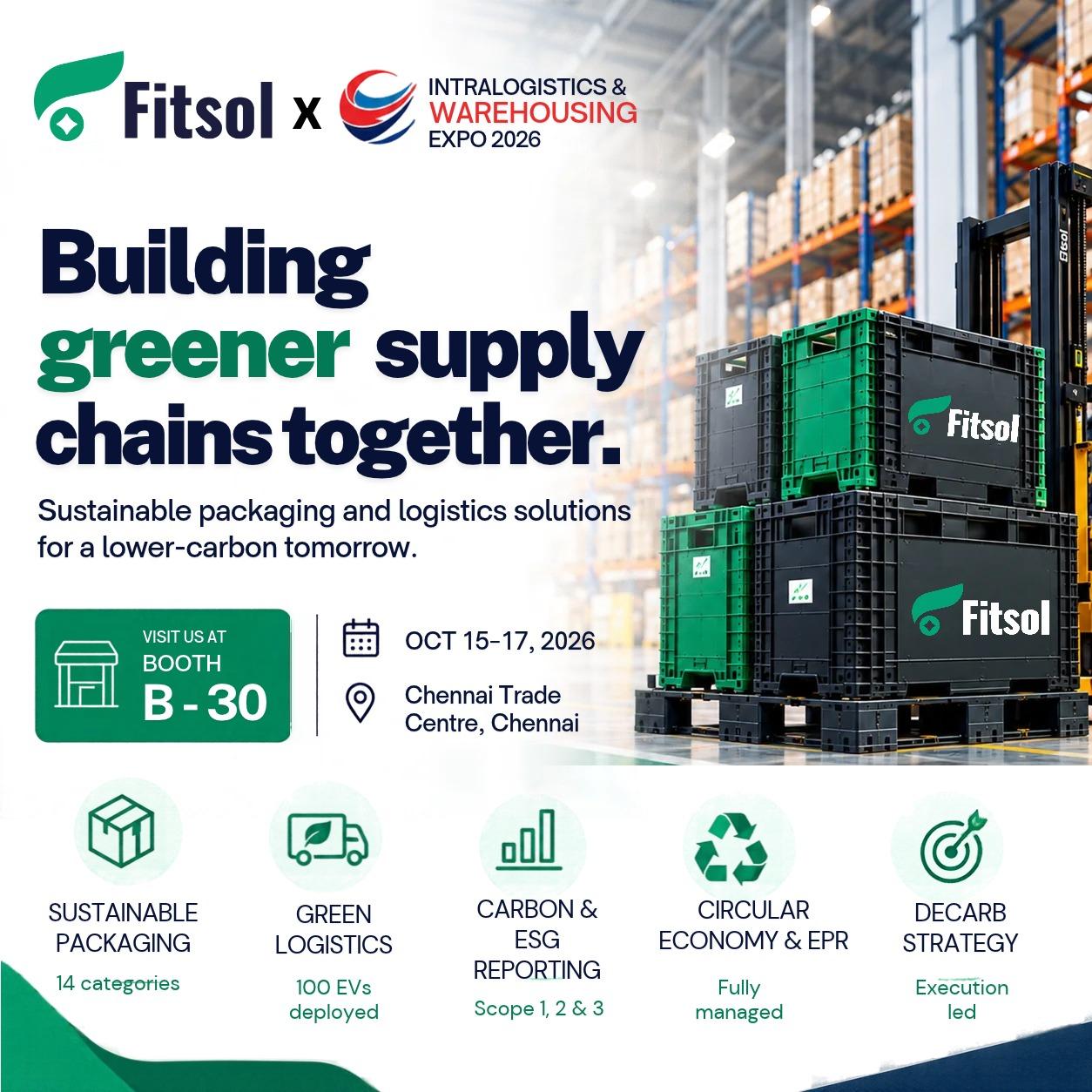
Meet Fitsol at the Intralogistics & Warehousing Expo, Chennai

Fitsol will be at the 6th Intralogistics & Warehousing Expo, held on 15, 16 and 17 October 2026 at the Chennai Trade Centre, Chennai. Find us at Booth B-30.
Come and talk to our team about running warehouses and logistics at lower cost and lower carbon: managed EV fleets, patent-filed reusable packaging with BLE asset tracking, and the GHG reporting to prove it.
📅 Date: 15, 16 and 17 October 2026
📍 Location: Chennai Trade Centre, Nandambakkam
🏷️ Booth: B-30
Join our LinkedIn community, The Decarbonisation Exchange: Procurement · Supply Chain · Sustainability, and WhatsApp network, Net Zero Community, for ongoing discussions, insights, and updates and Volt.Bolt.Go. for conversations around the EV ecosystem.