

The Take
What the GHG Protocol’s Scope 3 Revision Really Means for Your Emissions Data
Akshay Tandon, CTO & Co-Founder, Fitsol
Scope 3 has been treated as a quagmire for so long that most companies have stopped expecting to solve it. I think that acceptance is the real problem itself, in some cases even more than Scope 3.
Here’s a question I still ask in client conversations: is your Scope 3 emissions figure measured, or inferred from money spent? Too often, a single reported number, let’s say, emissions from purchased packaging, is really just spend multiplied by an industry-average factor, not anything specific to that supplier or that shipment. In my understanding, spend-based estimation was never a measurement. It was a correlation dressed up as one, and standards let it go unlabeled for over a decade.
In March, GHG Protocol proposed its first real Scope 3 revision since 2011; companies would finally have to disclose which kind of number they’re reporting. While this was a welcome move toward actually cutting emissions, rather than just reporting a defensible-looking figure, the timeline then moved. GHG Protocol and ISO merged their standards, pushing the final version to 2028.
However, from where I see it, this delay is a genuine window, not an excuse to pause. Use it. Audit which of your Scope 3 categories are still spend-based today; most teams haven’t actually checked. It’s the same audit we run with clients before anything else: find the two or three highest-emission categories, and start replacing estimates with real supplier data now, not in 2028.
The standard will catch up eventually. Whether your data does too is up to you.
Around the World: Trends Shaping Climate & Business
India and Finland strengthen partnership on circular economy
India and Finland are expanding their cooperation on the circular economy, with a renewed focus on turning sustainable solutions into investments and scalable business opportunities.
The partnership covers areas including waste management, recycling, resource efficiency, clean energy and sustainable design. More than 100 Finnish companies are already active in India across these sectors, creating opportunities for greater technology and business collaboration.
The announcement comes as Finland’s Minister of Climate and the Environment, Sari Multala, attended the World Circular Economy Forum (WCEF) 2026 in Gandhinagar, the forum’s first edition in South Asia.
Finland has also committed EUR 120 million through a blended-finance programme with IFC to mobilise private capital for sustainable development.
Source: ANI News
EU Parliament votes to widen CBAM to finished goods, Indian exporters now in scope
The European Parliament voted 464–50 to expand CBAM beyond raw steel, aluminium, cement and fertilisers. The proposed expansion would also cover finished products such as fasteners, wire, springs and household goods. MEPs have also pushed for tighter anti-circumvention rules.
A Temporary Decarbonisation Fund for 2027–2029 has also been approved to support EU producers facing carbon costs that are not priced into imports. The proposal now moves to negotiations with EU member states.
For Indian manufacturers, this could have a wider impact. CBAM may no longer be limited to raw materials. Exporters of downstream steel and aluminium products may also need to track and report their embedded emissions.
Source: ESG News
The EU Just Tied €2.5 Trillion in Public Contracts to Sustainability
The European Commission published a new public procurement regulation on September 14, 2026, consolidating three 2014-era directives into one framework where price is no longer the only thing that wins a contract.
Buyers must now weigh quality criteria, including environmental lifecycle impact, circularity, and resource efficiency, at a minimum 30% of the award decision. At roughly €2.5 trillion a year, about 15% of EU GDP, this isn’t a niche rule: any supplier bidding for EU public contracts, inside or outside the bloc, now has to substantiate sustainability claims to win, not just quote the lowest price.
Source: ESG Today
What’s New at Fitsol
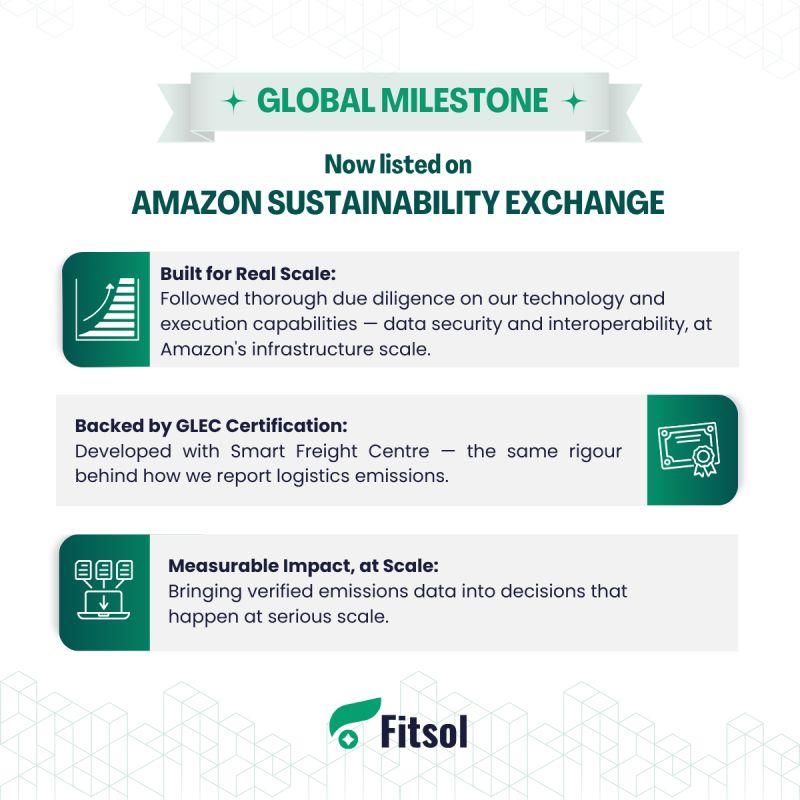
Fitsol Joins Amazon’s Sustainability Exchange

We’re excited to announce that Fitsol has been added to the Sustainability Exchange, a free website dedicated to helping companies of all sizes make progress toward net-zero carbon and more sustainable operations.
Amazon created the Sustainability Exchange to equip companies but especially its supply chain with practical sustainability tools and resources to help accelerate progress.
We’re proud to contribute a decarbonisation platform built for real supply chain execution, helping bring measurable emissions data into decisions that happen at serious scale. Being part of the Sustainability Exchange puts our Scope 3 measurement and decarbonisation capabilities directly in front of companies working through that exact problem, available for global suppliers, at scale. This listing followed through due diligence on our technology and execution capabilities, covering data security and interoperability at Amazon’s infrastructure scale. This builds directly on our GLEC certification, developed with Smart Freight Centre, the same rigour that underpins how we report logistics emissions.
Explore our resource and the full library of sustainability tools, playbooks, and more: here
Fitsol Takes Sustainable Supply Chains to the India Supply Chain Summit
Fitsol participated in the India Supply Chain Summit 2026, engaging with industry leaders on the challenges and opportunities shaping more sustainable supply chains. The conversations covered carbon intelligence, Scope 3, energy, packaging, sourcing and logistics, with a focus on turning sustainability goals into measurable, practical action.
For Fitsol, the conversation is simple: sustainability delivers value when it moves from strategy to execution.
Upcoming Events
The Carbon Table: Sustainable Packaging, Where Material Science, Regulation, and Commercial Reality Collide

Packaging sourcing isn’t just a cost conversation anymore. EPR compliance and supplier reliability now sit right alongside price, and most teams are still solving for them separately.
Join the next edition of The Carbon Table with Vikas Kalra, CBO, Fitsol; Rishu Gautam, Deputy Director, Indian Institute of Packaging; and Virag Bhardwaj, Joint General Manager, Procurement, International Tractors Limited (Sonalika).
The discussion will focus on the industry-execution, regulatory-technical, and buyer-side realities of sustainable packaging sourcing. Moderated by Onkar Madan, Sr. Product Manager, Fitsol.
Date: 30 September 2026
Time: 4:00–5:00 PM IST
Register here.
Fitsol Takes Sustainable Supply Chains to Intralogistics & Warehousing Expo 2026
If you’re dealing with rising logistics costs, inefficient warehouse operations, limited visibility across your supply chain, or pressure to reduce emissions, come meet the Fitsol team at Intralogistics & Warehousing Expo 2026.
We’ll show you how data-led solutions can help you identify emission hotspots, optimise logistics and warehouse operations, evaluate lower-carbon alternatives, and turn sustainability targets into measurable action.
Chennai Trade Centre, Chennai
October 15–17, 2026
Meet Fitsol at the expo and explore what your supply chain could improve next.
Join our LinkedIn community, The Decarbonisation Exchange: Procurement · Supply Chain · Sustainability, and WhatsApp network, Net Zero Community, for ongoing discussions, insights, and updates and Volt.Bolt.Go. for conversations around the EV ecosystem.