

What’s new at Fitsol
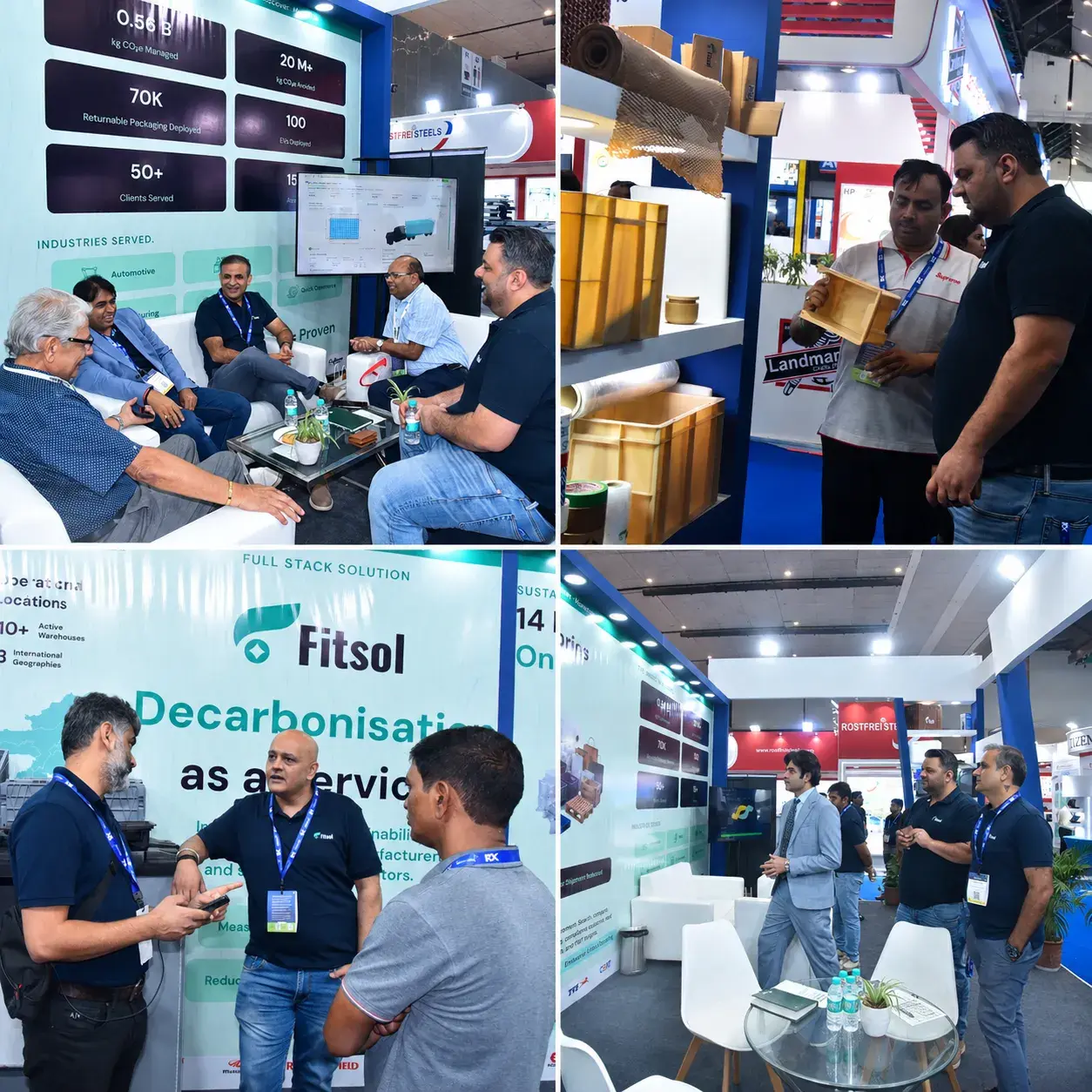
Fitsol at India Warehousing Show 2026
Fitsol exhibited at the India Warehousing Show 2026. The three-day event saw industry leaders and professionals engage in conversations across packaging, logistics, manufacturing, procurement, and supply chain. They also discussed some of the industry’s most pressing challenges, including sustainable packaging, EPR compliance, Scope 3 emissions, green logistics, and supply chain decarbonisation. At the booth, Fitsol also showcased solutions across sustainable packaging, GreenFind, carbon accounting, circularity, and green logistics.
The Carbon Table: Operationalising Procurement-Led Decarbonisation
If you’re facing challenges around supplier engagement, Scope 3 visibility, sustainable packaging, or embedding sustainability into procurement decisions, this conversation is for you.
The fourth edition of The Carbon Table brought together Navin Malhotra, Program Manager – Group Portfolio Sustainability at Capgemini, and Jasmine Kaur, Founder of Vera, to discuss how businesses can operationalise procurement-led decarbonisation across supply chains. The discussion focused on moving beyond emissions reporting to embedding sustainability into everyday procurement and supply chain decisions.
Watch the session here: Click to watch
Operational Milestones: Warehouse Expansion, New Facilities & Supply Chain Growth

Our operational footprint continued to grow across multiple locations. Rosemerta’s warehouse in Gaya commenced operations, while Safran’s Hyderabad facility moved closer to full operational readiness with multi-phase training underway. In Pune, 180 units were successfully dispatched for Kubota, and a new Master Service Agreement (MSA) was signed with Endurance. Also, in Bhiwadi, a buy-and-sell cycle for Craftsman was successfully completed, delivering a 30% operational margin.
Returnable Packaging Scaled Across Automotive Supply Chains
On the logistics and packaging front, 7 organisations across automotive manufacturing and engineering — 13,000+ returnable PP boxes deployed for Rico Jinfi (scaling to 20,000 by July), new returnable packaging programmes connecting Halol–Hosur and Halol–Pune for Rockman Industries, and PP box solutions for Escorts Tractors through Dawn Motors and Osho Tools.
EPR Compliance Delivered Across Multiple Industries
On the circularity front, EPR compliance was successfully delivered for organisations across 7 sectors — Battery, Electronics & Electrical, Automotive, FMCG, FMCD, Cement, and Agriculture — with end-to-end CPCB compliance, documentation, and audit readiness managed by Fitsol.
Fitsol Insights
India’s Expanded EPR Framework: Is Your Supply Chain Ready?
Your packaging supplier may now be your biggest EPR compliance risk.
India’s EPR framework is expanding beyond plastics to include paper, glass, metal packaging, and sanitary products, bringing many more businesses under its scope. The focus has shifted to whether your supplier network can support recycled content requirements, traceability, documentation, reporting, and compliance obligations.
To help businesses prepare, Fitsol has created a practical regulatory briefing covering the new framework, key compliance requirements, reporting obligations, and what organisations should do next.
Download the regulatory briefing here: Click to download
Around the World: Trends Shaping Climate & Business
Global CO₂ Emissions Rise Again, Highlighting the Need for Better Carbon Management
Global energy-related CO₂ emissions rose by 1.1% in 2025 to a record 35.8 billion tonnes. According to the Statistical Review of World Energy, United States accounted for nearly one-third of the increase. The rise in natural gas prices led to greater use of coal for power generation which caused the emissions to rise. The report is a reminder that businesses can’t reduce what they don’t measure. Tracking emissions helps identify hotspots and make smarter operational decisions.
Source: Investing.com
Court Ruling Puts Scope 3 Emissions in the Spotlight
A landmark ruling in France has reinforced the growing importance of Scope 3 emissions, signalling that businesses are increasingly being held accountable for emissions across their entire value chain—not just their own operations. In the case, the court directed TotalEnergies, a multinational integrated energy and petroleum company, to include Scope 3 emissions in its climate due diligence plan. As regulators and courts place greater scrutiny on value chain emissions, organisations need accurate data to measure, track, and reduce them. The takeaway is simple: if you don’t measure your Scope 3 emissions, you can’t effectively manage or reduce them.
Source: Le Monde
EU Advances Circular Economy with New Vehicle Circularity Rules
The European Union has approved new rules requiring vehicle manufacturers to design cars with circularity in mind, covering the entire lifecycle from production to end-of-life. The regulation introduces mandatory recycled plastic targets, stronger producer responsibility, and stricter requirements for vehicle take-back and recycling, accelerating the transition towards more circular automotive supply chains.
Source: ESG News
Join our LinkedIn community, The Decarbonisation Exchange: Procurement · Supply Chain · Sustainability, and WhatsApp network, Net Zero Community, for ongoing discussions, insights, and updates.